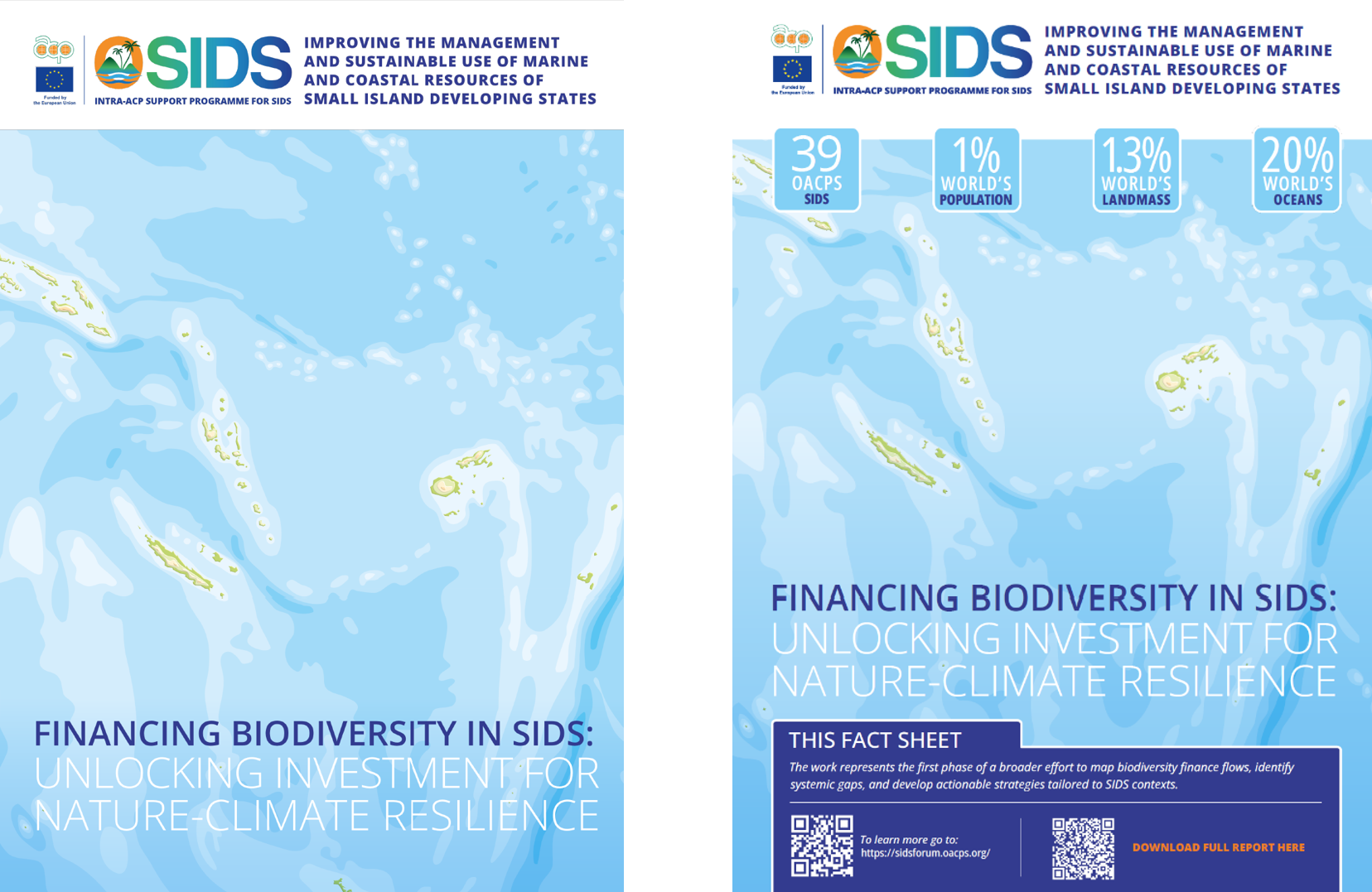
A new publication, Financing Biodiversity in SIDS: Unlocking Investment for Nature-Climate Resilience, calls for a fundamental shift in how biodiversity is financed in Small Island Developing States (SIDS), arguing that nature should be viewed not simply as an environmental asset, but as a cornerstone of economic resilience, fiscal stability and sustainable development.
The report was authored by Sandra Freitas, Laurel Parish and Tsaone Amogelang Mokwatso under the EU-funded Intra-ACP Support Programme for OACPS SIDS.
The publication provides the first comprehensive assessment of biodiversity finance flows across African, Caribbean and Pacific SIDS and presents a roadmap for mobilising greater investment in nature-based resilience. The authors highlight that while OACPS SIDS account for only around 1% of the world's population and 1.3% of global landmass, they steward approximately 20% of the world's oceans and host globally significant biodiversity resources.
The report underscores the critical role that natural ecosystems play in island economies. Coral reefs, mangroves, seagrass beds and forests provide coastal protection, support fisheries and tourism, and enhance resilience to climate change. Healthy coral reefs can reduce wave energy by up to 97%, while mangroves can reduce storm-surge heights by up to 66%, helping to protect communities, infrastructure and public finances. In many SIDS, nature-based tourism contributes between 30% and 50% of GDP, demonstrating the close relationship between biodiversity and economic prosperity.
Despite their importance, biodiversity remains chronically underfunded. According to the report, biodiversity-related financial flows to SIDS are often fragmented, unpredictable and heavily dependent on short-term donor-funded projects. Many countries struggle to access international finance because of limited institutional capacity and financing systems that continue to prioritise income-based eligibility criteria over vulnerability.
The authors argue that addressing this challenge requires a new biodiversity finance architecture built around long-term investment, stronger national institutions and innovative financing mechanisms. The publication highlights a growing range of instruments already being deployed in SIDS and other island contexts, including sovereign blue bonds, debt-for-nature swaps, reef insurance schemes, blended finance structures, biodiversity trust funds and blue carbon finance initiatives.
Among the examples cited are Seychelles' pioneering USD 15 million sovereign blue bond, launched to support sustainable fisheries and marine conservation, and innovative debt conversion operations that have demonstrated how environmental objectives can be incorporated into national financial strategies. These experiences show that biodiversity conservation can become an investable proposition capable of attracting both public and private capital.
The report also emphasises the importance of integrating biodiversity into national planning and budgeting processes. It recommends the development of biodiversity finance plans, biodiversity budget-tagging systems, dedicated nature-climate finance units, and stronger project preparation capabilities to help countries build investment-ready pipelines and access international financing opportunities.
Regional cooperation is identified as another key pillar for success. The authors highlight the role of regional organisations and financing platforms in pooling expertise, reducing transaction costs and scaling successful approaches across the African, Caribbean and Pacific regions. They point to mechanisms such as the Caribbean Biodiversity Fund as examples of how long-term financing arrangements can be developed beyond traditional project cycles.
Ultimately, Financing Biodiversity in SIDS: Unlocking Investment for Nature-Climate Resilience presents biodiversity not as a sectoral environmental issue, but as a strategic investment opportunity. By aligning finance with vulnerability, strengthening institutional capacity and scaling innovative financing instruments, the report argues that SIDS can transform their rich natural capital into a foundation for long-term resilience, sustainable growth and climate adaptation.
VIEW/DOWLOAD